





Offer your employees same-day counselling sessions with Spill
Learn more about Spill<div class="summary-block is-yellow">PLACE THIS ELEMENT BEFORE YOUR INTENTED BLOCK. THIS CREATED A YELLOW BLOCK</div>
- Mental health stigma involves treating people with a mental illness unfairly or differently.
- Initiatives like "Mental Health Awareness Week" challenge the cultural stigma of mental health issues but more needs to be done: an estimated 50% of work-related ill-health is due to stress, depression, and anxiety.
- As a leader, its important to challenge any mental health stigma that exists in your business, like avoiding language that signals negative perceptions of mental health, prioritising mental health days, or providing accessible mental health support.
What is mental health stigma?
Mental health stigma is a sticky kind of shame that’s placed on people who live with a mental illness, or who ask for help when they’re experiencing poor mental health. Stigma usually involves the act of treating someone differently or unfairly by marking them apart from the ‘norm’.
New research reveals that over a third of adults aged 16+ in the UK (36%) never talk about their mental health - the equivalent of 19.6 million people - due to the lack of obvious and comfortable spaces and people to talk to.
Every year we celebrate "Mental Health Awareness Week" to challenge the cultural stigma of mental health issues and to boost our willingness to talk about them.
In some ways, it's dispiriting that we still feel the need to raise awareness. It shows that social attitudes to mental health haven’t come as far as we think. Plenty of businesses still don’t readily accept that anyone struggling with depression, anxiety, or stress will find it hard to perform at work.
It’s estimated by the Health & Safety Executive (HSE) that 50% of work-related ill-health is due to stress, depression, and anxiety. That equates to 75 million sick days every year, and while it’s naive to suggest all of those days could be recovered, it’s reasonable to think that with a more progressive attitude we might see a significant reduction.
Aside from productivity taking a hit when people feel unwell, the dangers of allowing stigma and stereotypes of mental health in your organisation are broad and varied: from employees putting off treatment until they’re at breaking point, to underinvestment in support resources, an inability to relate to coworkers, or just plain, old-fashioned bullying. But there’s also a threat from a much less talked about mental health stigma – the one we impose on ourselves.
We asked Spill therapist Graham Landi to explain why people might fail to recognise themselves as someone who experiences poor mental health, and what impact that might have.
Self stigma and mental health: view from a Spill therapist
Many years ago, before training as a therapist, I worked in the corporate world.
I'd risen to a very senior level by the time my own emotional breakdown took hold and, having achieved a position of such authority it was hard to accept I wasn't coping. After all, I was paid to cope, wasn't I?
My GP would routinely sign me off work witnessing my alarming decline. In return, I would habitually fold up the sick note, put it into my suit pocket, and head back to the office.
There are several ways in which we stigmatise our own poor mental health.
The first and perhaps most destructive is through fear of judgement. We’ve become so used to other people dismissing depression, stress, and anxiety over the years that we start to do it ourselves.
The cycle of self-talk is a simple but devastating one:
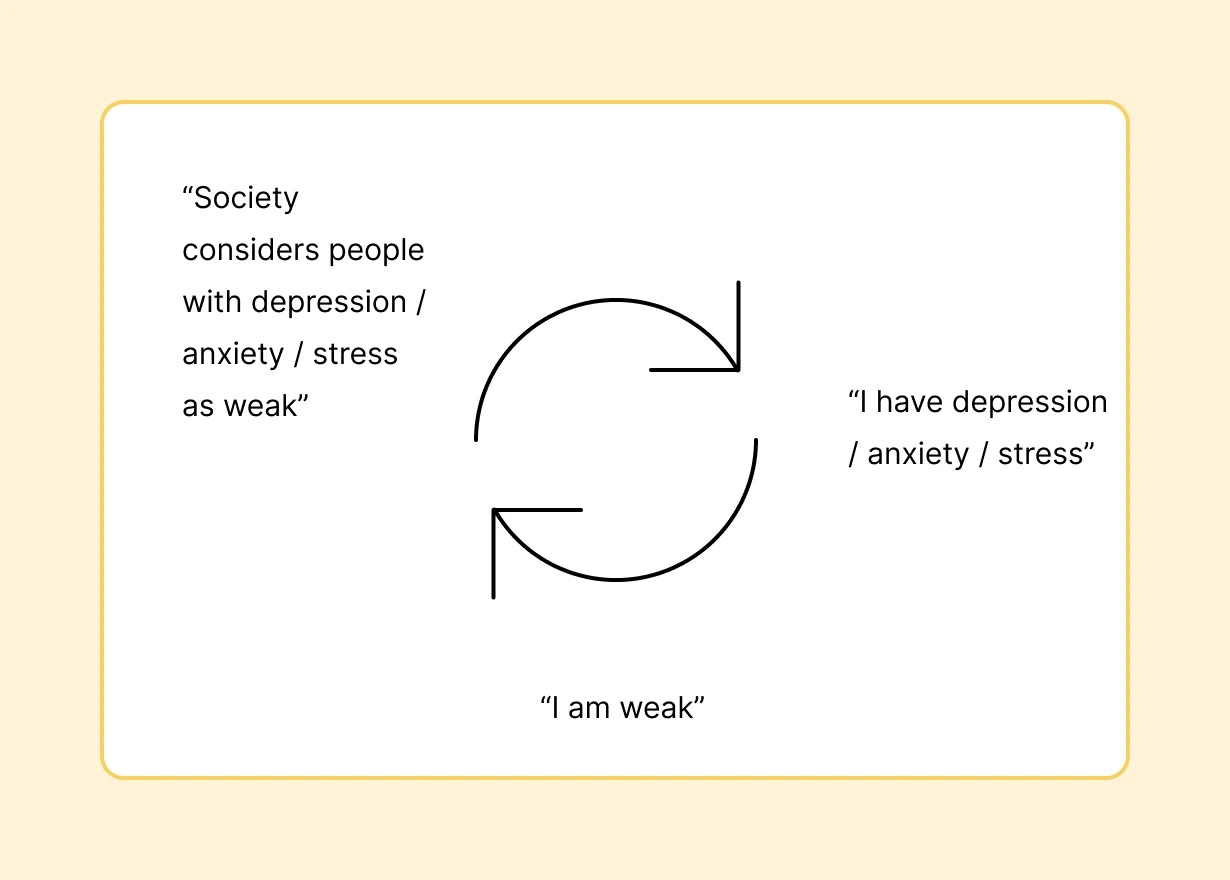
When we apply this thinking to the workplace, it gets even worse. Some classic examples of mental health stigma affecting your ability to recognise your own feelings and seek help might be:

The fear that others will write us off keeps us quiet and ashamed of our own increasingly desperate struggle until we add shame on top of whatever mental health issue we were already experiencing.
Instead of accepting that we might be struggling with our mental health, we insist it must be something else:

If you refuse to accept you are susceptible to mental health problems like everyone else, you will always find a different but inaccurate explanation. We scramble to avoid acknowledging the possibility that we might be emotionally overwhelmed.
Digging ourselves even deeper, we combat this denial by working harder, longer and faster, trying to prove our own indestructibility until our physical bodies ‘let us down’. Inevitably, we burn out.
One of the most helpful interventions for people who stigmatise their own mental health condition is challenging their negative self-beliefs.
If your employees work in a culture that sees speaking up about mental health difficulties as a strength, they’re more likely to question their own dysfunctional self-image.
As an employer, you want to celebrate the courage it takes to acknowledge a mental health issue and support workers who might be struggling. So, how do you create a culture that reduces the stigma of mental health issues – not only by telling people it’s safe for them to speak up when they are experiencing emotional difficulty, but by taking action when it counts?
Breaking the stigma around mental health in the workplace
Often, HR and People teams have got their ducks in a row when it comes to an action plan for workers experiencing poor mental health. (But if that sentence filled you with panic, then check out our guide to creating your own mental health policy). Often, what gets stuck is a clear line of communication between the People team and the managers on the front line.
If leaders tell their teams that it's OK to struggle with mental health, but there’s little evidence of strong support when it happens, then don't be surprised if your people stay quiet until they’re feeling properly unwell.
Here are some practical ideas to challenge any mental health stigma that exists in your business. We’ve ordered them from low-high in terms of effort and investment, but every single one is sure to have an impact.
🥉 Low effort: avoid language that perpetuates negative perceptions of mental health
Whenever you’re communicating with your team, try to be purposeful with your language. Some phrases seem harmless but can cause us to internalise harmful ideas and stigmatise mental health as a result. That might be
- Trivialising language, like “I’m a bit OCD about my pencil case,” when you mean you’re particular about your pencil case; or “It’s raining, how depressing,” when you just mean “It’s grey out.”
- Loaded language, like “Can I get a sanity check on this spreadsheet?” (Try asking for a sense check, instead.)
- “Bad mental health” sounds judgemental, and permanent. “Poor mental health” sounds more like it’s on a spectrum, and something that we can all experience from time to time.
🥈 Mid effort: make mental health more visible in your company
- Set a precedent from your first interaction with people to prevent mental health stigma from the start. When you’re hiring, ask candidates whether they would like any adjustments made to the ‘usual’ interview process. You might be surprised by the small changes that’ll make a difference.
- If you’re having a hard day, or you’re feeling off, let people know. Nobody can work at 100% capacity every day, and it’s about time we normalised it. Encourage your leaders to do the same.
- Discuss mental health provisions, resources and benefits in company-wide meetings and emails.
- If you’re taking a walk for your mental health, or you’re taking an hour off for therapy, add an emoji to your Slack status to share with colleagues and make self-care more visible.
🥈 Mid effort: prioritise mental health days – and not just for recovery
If you haven’t already, implementing (and shouting about) a mental health day policy can be extremely beneficial for your business. Taking a day off shouldn’t be a last resort once employees are already emotionally exhausted and their performance is suffering at work.
Unplanned mental health days should be encouraged as a way to regroup and look after your mental wellbeing when you feel overworked, but before you reach burnout. As a business, it’s important to note that this paid time off will still offer better value than ongoing presenteeism, where a worker shows up for work day after day but is unable to think or perform at full capacity.
To break any stigma around mental health in your team, you’ll need to demonstrate that there are no negative consequences of taking time off for mental health reasons. When colleagues see that time off is treated the same whether you’ve emotionally burnt out or broken a leg, it creates long overdue equality between a physical and mental illness that is hugely constructive for the workplace, and society more generally.
🥇 High effort: provide mental health support in work time, in work spaces
- Keep track of your team’s mood via a regular wellbeing survey, and share insights from it regularly. Just knowing that you’re not the only one feeling tired or run down can open up new conversations between colleagues and fight mental health stigma at the same time.
- Set a budget for mental health, in the same way that you might set a budget for gym memberships or medical insurance. And spend that budget on mental health support that’s set up for the way your business actually works. If your budget is low to start off with, you might consider an Employee Assistance Programme (EAP), or if you’d rather make anonymous support accessible to your teams directly through Slack or MS Teams, you could try comprehensive mental health support, like we offer at Spill.
- Train Mental Health First Aiders in your team to spot anyone who might be struggling and proactively signpost appropriate resources.
- If you already provide access to counselling or corporate therapy, make sure that people know they can take part during work hours. Make feedback loops visible, too. At Spill, we invite people to share their feedback for therapy anonymously in a public Slack channel.
Because the stigma surrounding mental health can be so pervasive in workplace cultures, it can be a hard problem to root out. And that’s especially true when we are unknowingly applying that stigma to ourselves. But creating a business where speaking up about mental health issues is not only accepted but actively celebrated is key to looking after your team and building a psychologically-safe workplace.
learn more
