

See how much Spill's EAP would cost your business
See pricing<div class="summary-block is-green">PLACE THIS ELEMENT BEFORE YOUR INTENTED BLOCK. THIS CREATES A GREEN BLOCK</div>
- In 2025, employer-sponsored health insurance premiums averaged $9,325 a year for single coverage and $26,993 for family coverage, with employers paying roughly 84% and 74% of those totals respectively.
- Numerous factors affect employee health insurance costs: under ACA small group rules, premiums can vary by age, location, family size, and tobacco use, plus the richness of the plan you choose.
- There are ways to lower the monthly cost of employee health insurance, like raising deductibles, pairing a high-deductible plan with an HSA, and claiming the Small Business Health Care Tax Credit.
- The cost of employee health insurance is generally worth it (and companies with 50 or more full-time employees are required to offer coverage), but if it's mental health you want to properly support, you’d be better off adding a specific mental health solution like Spill.
- Proactive mental health screening and personal therapy programs generate the highest return on investment for employee wellbeing solutions, at around 6.3 times the amount invested.
With companies tightening their belts amidst the rising costs of, well, everything, a new trend has made itself known in 2023: the perk-cession. First coined by the Wall Street Journal, the perk-cession is causing companies to take a closer look at their employee benefits program. But in the face of decreasing levels of employee wellbeing, how do they decide what stays and what goes?
Employee health insurance is usually the single biggest line in the benefits budget and, like everything, it comes at a price. But what is the true cost of employee health insurance? And if decisions need to be made over which benefits to keep, should you be prioritizing physical or mental health care for your team?
Let's find out. Here, we’ll guide you through the cost of employee health insurance, and weigh up whether buying health insurance for employees is really worth it from both a financial and business perspective.
How much does employee health insurance cost?
In 2025, the average premium for employer-sponsored health insurance was $9,325 a year for single coverage and $26,993 for family coverage. After workers' contributions, employers paid an average of about $657 per employee, per month for single coverage.
It’s one of the first questions business owners want to know when it comes to introducing (or keeping) a company benefit: how much will this cost?
For health insurance, employers paid an average of about $7,885 per employee per year towards single coverage in 2025 (roughly $657 a month), rising to around $20,143 per year (about $1,679 a month) for each employee on family coverage. But, your figure could be higher (or lower) depending on your plan design, your team’s ages, and your location (more on that later).
To give you a clearer idea of the cost of health insurance for small businesses in particular, the KFF survey breaks its premium data down by firm size. It’s worth noting that small firms pay nearly the same average premiums as large firms: $9,211 versus $9,361 a year for single coverage, and $26,054 versus $27,280 for family coverage. Plus, providers tend to offer optional add-ons, which will add to the monthly cost.
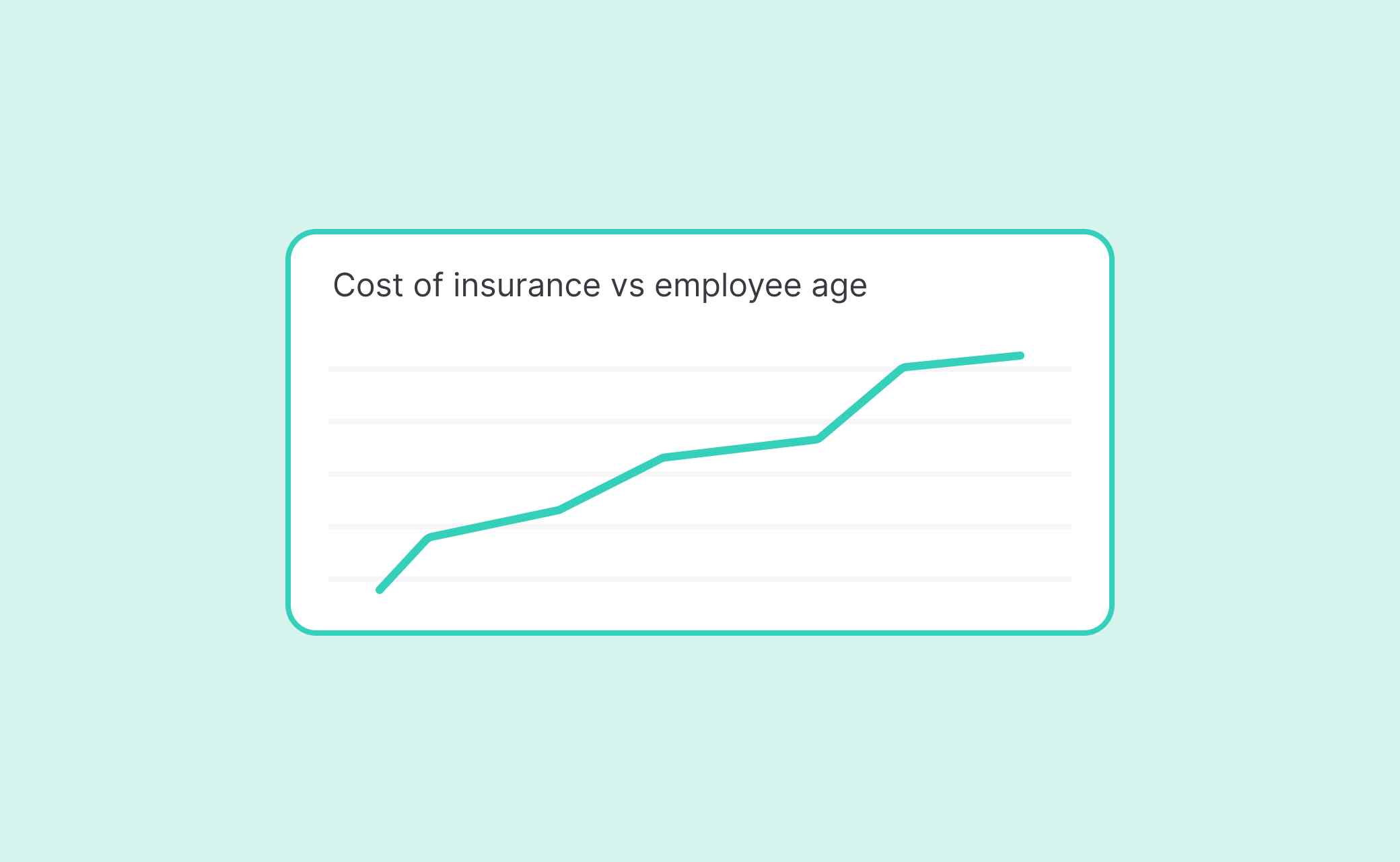
The figures in the graph below are indicative market averages, not the exact quote your business will get.

As expected, the total monthly cost of employee health insurance increases with the number of employees on a team, and with their age: ACA rules let insurers charge older adults up to three times more than younger ones. Now, we’re not assuming that everyone in your team falls within the same decade but hopefully it gives you an approximate idea of what your monthly (and therefore yearly) outlay could be.
Tax implications of employee health insurance costs
Employee health insurance gets some of the most favorable tax treatment of any benefit in the US, which softens the impact of those premiums on your business (i.e. the sticker price isn’t quite what it seems).
Employer premium contributions are generally a tax-deductible business expense, and they’re also excluded from your employees’ wages for federal income and payroll tax purposes. And don’t worry, there’s more good news below!
If you have fewer than 25 full-time equivalent employees with average wages below the IRS threshold, there’s also the Small Business Health Care Tax Credit: buy coverage through the SHOP marketplace and pay at least 50% of employees’ single-coverage premiums, and you can claim a credit worth up to 50% of your premium contributions.
What is the cost of health insurance for employees?
The whole point of employee health insurance is that it’s a perk for your team, but there can still be a cost for them depending on how you offer it.
If you buy employee group health insurance for your team, you’ll pay most of the monthly premium and your employees will typically pick up the rest: in 2025, workers contributed an average of $1,440 a year towards single coverage (16% of the premium) and $6,850 towards family coverage (26%). Depending on the plan, employees will also pay a deductible towards their treatment before the insurance takes over ($1,886 on average for single coverage), plus copays or coinsurance after that, but they’ll still benefit from an annual cap on their total out-of-pocket costs.
Alternatively, you can offer a high-deductible health plan (HDHP): for 2026, the IRS defines this as a plan with a deductible of at least $1,700 for single coverage. Employees shoulder more of the early costs, but premiums are lower and they can save pre-tax in a health savings account (HSA) to cover them.
However.
There’s also a slightly hidden saving in employee health insurance for your team in the form of tax. If you run your plan through a Section 125 cafeteria plan, your employees’ share of the premium comes out of their paycheck before tax. That lowers their taxable income every month. It’s worth noting that those pre-tax premiums escape both federal income tax and payroll taxes, which is a nice tax saving if you ask us!
⚠️ It goes without saying that we’re not giving out financial advice: please speak to your accountant, tax advisor, or the IRS directly to fully understand the tax implications of offering employee health insurance.
What affects the cost of employee health insurance?
Unlike other wellbeing benefits, such as gym memberships, employee assistance program (EAP) contracts, or indeed Spill’s rolling monthly subscription, employee health insurance costs change based on more than just the number of people on your team.
5 factors that change the cost of employee health insurance
1. The cost of employee health insurance changes depending on the level of cover
The specific details of every employee health insurance plan vary but one thing remains constant: the more comprehensive the cover, the more expensive it will be. By cover, we mean what the insurance policy includes. Most carriers offer a base plan with the option to add extras onto your policy, like dental and vision coverage, richer prescription benefits, and broader networks (a PPO typically costs more than an HMO).
2. The cost of employee health insurance changes depending on your team’s age
It’s a sad fact of life that as we age, our health deteriorates and our need for healthcare gets priced in: under ACA rating rules, insurers can charge older adults up to three times more than younger ones for the same plan. Insurance companies will charge a higher monthly premium for older team members, which will increase your total monthly spend.
3. The cost of employee health insurance changes depending on your team’s health
In the US, three in four adults live with at least one chronic condition, so this is a fair worry. The good news: ACA rules stop small group insurers from charging more based on your team’s health status or medical history, and pre-existing conditions can’t be excluded from coverage. The main exception is tobacco: in most states, insurers can apply a premium surcharge of up to 50% for employees who use it (and if you’re a larger or self-funded employer, your team’s actual claims history will shape your renewal price).
4. The cost of employee health insurance changes depending on your business type
Each company’s line of work comes with its own set of risks: a construction company has very different risks than an office-based company, for example. For small group plans, ACA rules actually bar insurers from rating by industry, but if you’re a larger, experience-rated group, or you choose a level-funded or self-funded plan, your industry’s risk profile will affect the price of your plan. Remember, the more likely your team is to make claims, the higher the cost may be.
5. The cost of employee health insurance changes depending on the location of your company
Healthcare varies in cost around the US: insurers price plans by geographic rating area, so the same coverage can cost far more in one state (or even one county) than another. Likewise, if you’re a distributed team, it might be more expensive to get coverage that works on a national level: for example, plans with broad national PPO networks cost more than narrow-network local HMOs, but they give employees in every state somewhere in-network to go.
5 ways to reduce the cost of employee health insurance
The cost of employee health insurance is considered one of the more expensive company perks, but it’s also one that benefits both you and your team. Here are five things you can do to offer cover while keeping costs down.
1. Increase the deductible
The deductible is a pre-agreed amount (set by the plan you choose) that your employees pay towards their care each year before the insurance kicks in: among covered workers who have one, the average for single coverage is $1,886. By choosing a plan with a higher deductible, the cost of the premium will be reduced. This is generally considered a good option for younger teams with a lower likelihood of claims.
2. Pair a high-deductible plan with an HSA
It’s possible to cut premiums by choosing an HSA-qualified high-deductible health plan: for 2026, that means a deductible of at least $1,700 for single coverage. Considering 29% of covered workers are already enrolled in these plans, it’s a mainstream choice rather than a fringe one. But, it does mean employees pay more before their coverage kicks in, so many employers soften the deal by contributing to the HSA themselves (employees can put in up to $4,400 pre-tax for single coverage in 2026).
3. Set eligibility criteria
By setting certain criteria for joining your company’s health insurance plan, you can reduce the number of people covered by the policy. It goes without saying that any restrictions need to be non-discriminatory and legal: the ACA caps eligibility waiting periods at 90 days, and employers with 50 or more full-time employees must offer coverage to substantially all of them. Popular criteria include things like only covering full-time members of staff (employees working under 30 hours a week can be excluded) or only enrolling employees once they’ve completed the waiting period.
4. Claim the Small Business Health Care Tax Credit
If you have fewer than 25 full-time equivalent employees and average wages below the IRS threshold, buying coverage through the SHOP marketplace and paying at least 50% of employees’ single-coverage premiums can earn you a tax credit worth up to 50% of your contribution. The smaller the business, the bigger the credit: if you’re looking to cut costs, it’s the closest thing to free money in the group insurance market.
5. Do your research
It might sound obvious but just like bringing anything into your business, employee health insurance needs researching. Getting a quote directly from an insurance provider might be easy (we get it, insurance is complicated), but remember: they’re good at selling. Gather multiple quotes (a licensed broker can do this legwork, and carriers pay their commission), research the policies, get advice, and talk to your team: you need to make sure the coverage you get actually covers their needs. And if you’re up for renewal, take the time to shop around for new deals rather than just letting your contract roll over.
Is the cost of employee health insurance worth it?
Finding independent return on investment (ROI) data on employee health insurance has proven tricky, which in itself might be telling. The headline study comes from Avalere, commissioned by the US Chamber of Commerce, which estimates that employers with 100 or more employees get back $1.47 for every $1 they spend on health benefits, a 47% ROI. But, it was commissioned by a lobby group with an interest in the answer, so treat that precise figure with some care.
Ultimately, we think it boils down to the problem you’re trying to solve.
It goes without saying that there are some companies that operate in an industry that’s more prone to physical injury: construction, agriculture, and manufacturing all come with risk of injury and work-related ill health. Year after year, Bureau of Labor Statistics injury data show construction, agriculture, and manufacturing among the industries with the highest rates of workplace injuries and illnesses, and for teams doing physical work, comprehensive medical coverage is non-negotiable.
Clearly, that’s an industry that could benefit from physical health insurance, but the facts and figures about mental health at work in general tell a very different story. In short, the workforce generally needs more mental health support than physical. And with US workers who rate their mental health as fair or poor missing an estimated 12 days of work a year (nearly five times more than everyone else), we think there’s a strong case for putting your money towards proper mental health support rather than the diluted support that’s often tagged on to health insurance.
The cost of mental health support with Spill
Spill is a digital mental health provider that makes effective therapy accessible, affordable, and free at the point of use. Everyone in your team can benefit from therapy with Spill: there’s no exclusions clauses whatsoever and with therapists covering 80+ areas of expertise, your employees can get specialist support from the top 13% of qualified therapists.
With Spill, there’s no need to compromise on treatment in order to save pennies:
- We don’t raise prices based on employee age or industry
- There are no deductibles or copays to pay
- There’s no waiting list at all
- We include pre-existing conditions (and don’t charge more for their care)
- You can start by covering one employee or cover the whole team
- Our lowest price is available with no annual contract
In short, we recognize that everyone, at all times in their life, can benefit from mental health support.
Let’s look at a team of 15 people: five of them are in their late 20s, six are in their early-mid 30s, and four are in their 40s.
For employer-sponsored coverage, KFF’s 2025 averages put the employer’s share at about $7,885 per employee per year for single coverage: roughly $9,850 a month for all 15 employees, and that’s before anyone adds a spouse or children (family coverage lifts the employer’s share to around $20,143 per employee per year). The mental health support in that coverage exists on paper, but in practice employees have to find an in-network therapist with room for new clients, and only around 55% of psychiatrists accept private insurance. And remember, until each employee meets their deductible ($1,886 on average), most therapy sessions come out of their own pocket.
At Spill, you’d be looking at a flat monthly subscription for all 15 employees, with a plan that includes unlimited message-based support and drop-in counseling sessions, plus an option that adds unlimited structured counseling for mental health issues. The statistics show that more than one in five adults struggle with their mental health in a given year: in a company of 15, that’s at least three people. With Spill, every one of them can book a session for as soon as the next day, at no cost to them.
So, for a small fraction of what the premiums cost, you can give the struggling members of your 15-person team free access to a luxury that’s all too often unaffordable: therapy in the US typically costs $100 to $200 per session out of pocket. Plus, that price isn’t going to change based on age, or industry type, either. It also includes anyone with a chronic or pre-existing mental health condition.
But Spill isn’t just about offering therapy: we provide proactive mental health care, too. Our unique algorithm proactively screens your team and flags anyone who’s struggling. And then, one of our therapists reaches out to offer them tailored support. This combination of proactive mental health screening and personal therapy offers businesses the highest ROI when it comes to wellbeing solutions. Deloitte’s research puts the return at around 6.3 times what you put in.
Invest in solving the right problem
We’re not saying that the cost of employee health insurance isn’t worth it. What we’re saying is, think carefully about the problems facing your team and the right solution to solve them. If your company is suffering due to low mood, anxiety, depression, loneliness, burnout, or any other mental health challenge, a specialist therapy provider is your solution. And it’s not just needed, it’s wanted, too: 81% of employees say they’ll be looking for workplaces that support mental health in their next job search. And that could be you.
